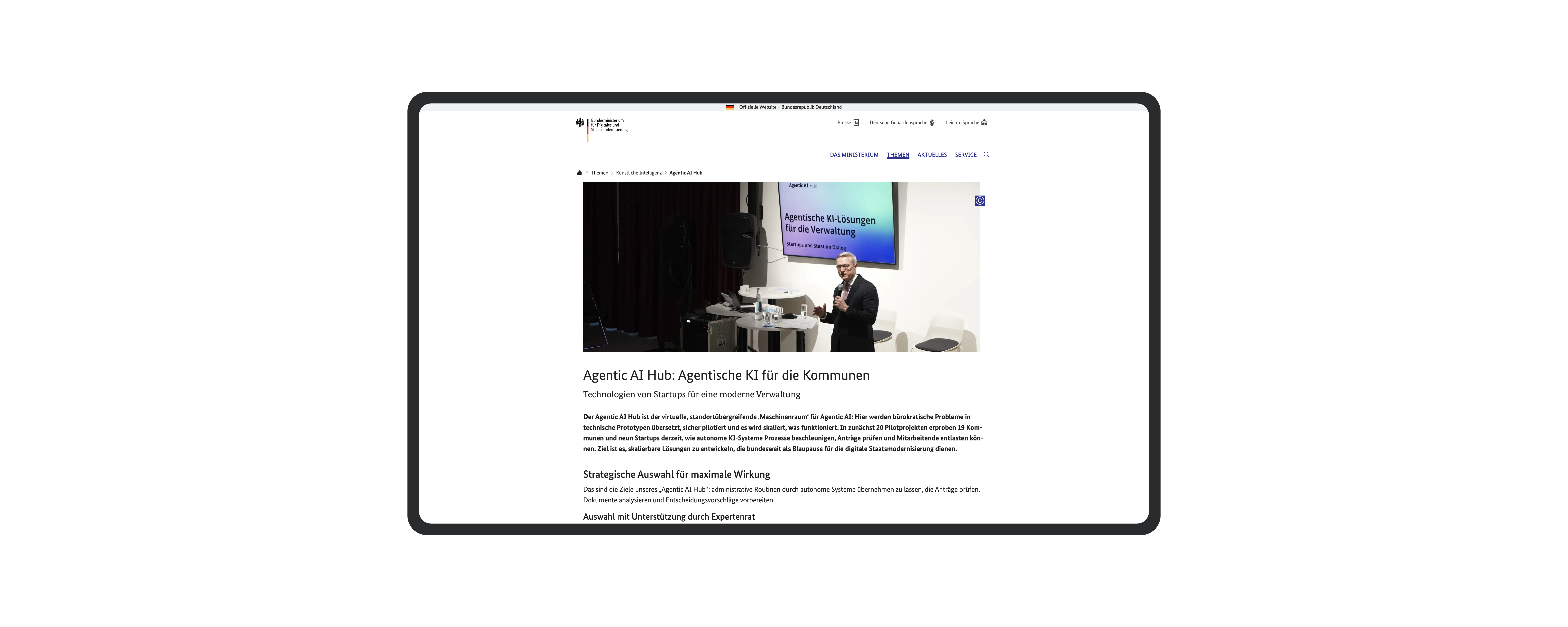
Agentic AI Hub
Shaping the future of public administration
The Agentic AI Hub brings together start-ups and public authorities to turn technological innovation into practical application in public administration. The result: scalable solutions that will serve as a blueprint for digital government modernization right across Germany.
With the Agentic AI Hub, the German Federal Ministry for Digital Transformation and Government Modernization (BMDS) has ushered in a new era of digitalization of public administration. The focus is to transfer routine administrative tasks to autonomous systems that will review requests, analyze documents, and prepare decision proposals.
Expert advice during project selection
Within a structured process, BMDS and DigitalService selected 20 pilot projects involving 19 municipalities and nine start-ups. By validating these solutions in practice over three months, we will be able to identify the requirements and barriers at an early stage as well as pathways towards broad application. The Hub is supported by a panel of specialists from science and industry, including experts from UnternehmerTUM, Merantix and the Association of German Cities. It received approximately 400 applications from start-ups and almost 200 from municipalities. The projects were then selected based on their strategic fit, representativeness and scalability. Some of the start-ups are working with several municipalities, while a number of the municipalities are also using two solutions from different start-ups to directly assess the comparability of the approaches.
Five application categories
In this cooperation to scale agentic AI in a targeted way, five defined areas of application are covered:
- Simplified citizen interaction: automated mail processing and communication
- People-centered processes: digital support for social benefit and care applications
- Internal administrative processes: efficient documentation and meeting transcription
- Digital tools: intelligent process modeling and data improvement
- Infrastructure: building sovereign layers for AI applications
Broad range of pilots in real-world testing
Nine start-ups and 19 municipalities are trialing solutions in key areas such as social benefits, meeting transcription, and process management. These involve using agentic AI to support the application process for the WBS, the housing entitlement certificate, (Forml), housing assistance (Leistungslotse), long-term care assistance (Myosotos), and more, and thereby reducing the processing time in administrations in Düsseldorf, Berlin, Nettetal, and elsewhere. In addition, complete processes are being set up, for example in relation to naturalization in Munich (Celonis), and entire administrative processes are being modeled, such as in Schwerin (SUMM AI). In Borken, deepset is implementing a technology-agnostic AI orchestration layer (Haystack) to ensure scalable, sovereign AI applications. And in Bielefeld, Tucan and Speechmind are testing automated, privacy-compliant transcription of internal and external meetings to ease the burden on staff. In Neckar-Odenwald, Lector.ai is trialing an automated pre-sorting solution to help municipalities handle high volumes of incoming requests.
For three months, from March to the end of May 2026, the pilots are working on the specific implementation within the municipalities and will be assessed for effectiveness and scalability. Unsuccessful applicants will also remain part of the Hub concept, forming a community for exchange and further development. There will be regular events and networking formats to support this. Given the large number of suitable projects, we are also in discussion on a second cohort of pilot projects.
Status: Development
BMDS topic page
Press release and start
Questionnaire for municipalities for the second pilot project
Questionnaire for start-ups and scale-ups for the second pilot project
Contact the project team: aaihub@digitalservice.bund.de
Special features
- Government as the anchor customer: The Hub opens up the public market to domestic AI start-ups and, through public contracts, gives them the stability and credibility they need for global growth.
- Capacity to act: Agentic AI can help address the severe shortage of skilled workers in public authorities and ensure government works quickly and reliably despite the need for additional staff.
- Digital sovereignty: By supporting its own values-based solutions, Germany is reducing its dependence on external tech solutions and retaining control of data and processes.
Facts and figures

Almost 600 applications within a two-week application period – 400 from start-ups and 200 from municipalities.

Major cities like Düsseldorf and Berlin are covered by the pilots, along with small districts such as Elbe-Elster and Neckar-Odenwald.

Twenty pilot projects that will create a (legal, organizational, and technological) framework for productive and scalable use of agentic AI by the end of May 2026.
Dr. Karsten Wildberger, Federal Minister for Digital Transformation and Government Modernization
It is not enough for us to just discuss AI in Germany – we want to act. With the Agentic AI Hub, we are now using AI agents in a very practical way in public administration and strengthening our digital capabilities.