


11. March 2026
author:
Birga Köhler |
Benedikt Liebig
How we work at the Center for Better Regulation
Nowadays, hardly any new regulation can be implemented smoothly and fully digitally from the outset. For years, the National Regulatory Control Council (NKR) has warned that when regulations are adopted without taking technical realities and those affected into account, the result is bureaucracy instead of relief and frustration instead of trust in the rule of law. At the same time, policy drafters face growing pressure to regulate increasingly complex issues as comprehensively and in as much detail as possible, often under tight deadlines. In doing so, they encounter a patchwork of working aids, checklists, and guidelines that is more overwhelming than genuinely helpful. If the state is to remain capable of acting, legislation must be modernized. This is precisely where the Center for Better Regulation comes in. We show how we develop and implement its services.
Effective lawmaking for an efficient state
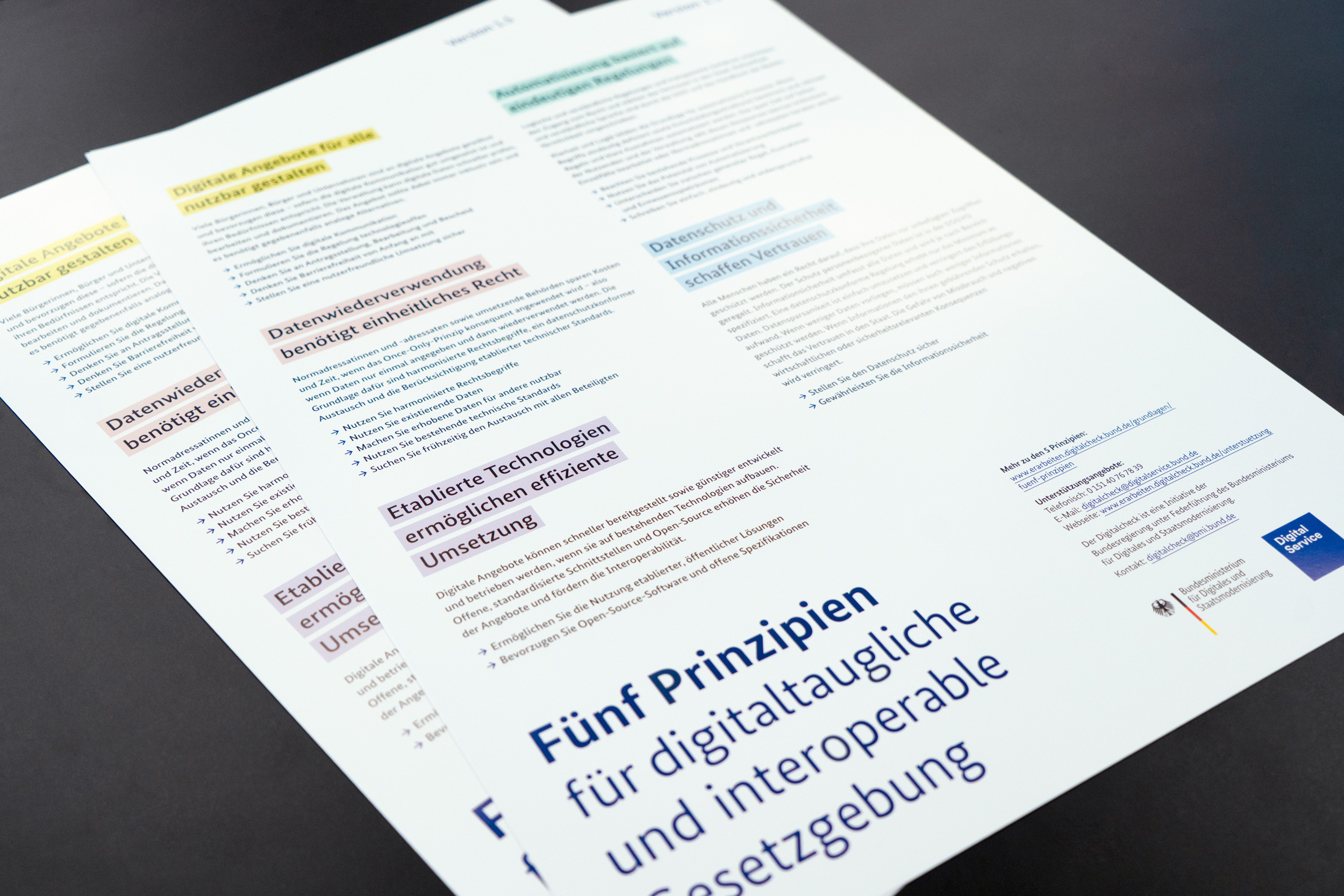
Since the Digitalcheck was introduced back in 2023, we have been helping policy drafters to develop and implement digital-ready legislation, gaining valuable experience along the way. We now know which methods and areas of expertise are needed to ensure that laws are digitally implementable, practical, and compatible with administrative processes. At the same time, it has become clear that merely imposing formal requirements is not enough. Simply requiring regulations to be designed in such a way that they facilitate automation, take data protection and IT security into account, and are written in an understandable manner is not enough. Digital implementability is not achieved by applying a defined set of criteria – it requires a change in working practices. Policy drafters must be in a position to rethink processes, understand technical requirements, and take interdependencies into account at an early stage. This makes lawmaking a modernization task in its own right: administrative staff must be empowered for the long term. And they need a reliable service offering that supports them throughout the entire legislative process.
The political mandate for such a service offering is anchored in the German government’s modernization agenda (German only) and the federal modernization agenda (German only), in which the German government has agreed on measures for an efficient state. Regarding improved lawmaking, this includes the establishment of the Center for Better Regulation (German only). By serving as a central platform and point of access, it is intended to support the drafting of policies that are practical, tailored to those it affects, suitable for digital implementation, and light on bureaucracy. Different methods – including Digitalcheck, Bürgercheck, and Praxischeck – will be consolidated and further developed under the umbrella of the Center for Better Regulation going forward.
This also broadens our perspective. The Federal Ministry for Digital Transformation and Government Modernization has been working with DigitalService to establish the center since early 2026, with a mandate to examine ministerial legislative drafting in a holistic way. We are therefore no longer focusing exclusively on ensuring the digital readiness of individual regulations. Rather, we can now systematically address different legislative problem areas and develop integrated solutions. Our vision: Policy drafting should work effectively and in a targeted way for both citizens and businesses and thereby provide the foundations for an efficient state. To achieve this, we are mainly focusing on the early stage in the legislative process. We want to ensure that interdisciplinary expertise is incorporated from the outset when regulations are created and is imparted to policy drafters in a way that supports long-term effectiveness.
Exploring and prioritizing the legislative process
The challenge: We are modernizing a system that has evolved over time and need to ensure continuous service. Instead of starting with a blank slate, we have to gradually gain insight into existing structures and processes. Our solution development is consistently problem- and evidence-based. The starting point is assumptions regarding the key issues in the legislative process. These are derived from interview and usability test findings as well as feedback from trainings, support queries, and our day-to-day collaboration with legislative drafting divisions as part of our regulatory support. In this way, we combine qualitative insights with specific process experience.
However, we do not act on every identified problem area immediately. The key question is: what should we tackle first?
To decide this, we consider the service as a whole using a dynamic plan: the service blueprint. We look at all interactions across the entire service – the specific phases, activities, tools, and touchpoints needed for its delivery. We use clear criteria to prioritize these:
- Problems: At an early stage, we test what is, based on experience, especially challenging for policy drafters. Example: Concerns about potentially creating premature or negative public perceptions often limit early coordination with other authorities and implementing stakeholders.
- Added value: We concentrate on areas where we expect to have the greatest practical impact. To achieve this, we focus on the needs of the target group. We can then quickly deliver tangible benefits and help stakeholders embrace further change. Example: Simplification and consolidation of the different requirements of the current legislative process that “bureaucratize” the work of policy drafters.
- Dependence: We start with solutions with high dependencies. We expect systemic effects from these, as they affect multiple stakeholders at the same time. Example: The people with practical knowledge are involved in drafting legislation at an early stage.
- Deviation: We first address aspects that pose a significant risk to both effectiveness and acceptance by the target group. The risk comes from the fact that they deviate significantly from present legislative practice and are new. Example: The German government’s modernization agenda calls for a new early phase of lawmaking.
Instead of optimizing specific elements, we consider the full context and support the entire drafting phase. This means that we intervene at different points of the process and gradually develop a consistent, robust overall system. Every solution is developed with the aim of achieving lasting behavioral change in policy drafters.

Linking theory and practice
In addition to digital services, the Center for Better Regulation supports policy drafters with interdisciplinary teams. These complement the professional and legal expertise of the legislative experts by adding design, user research, software development, and product management competence. Several departments have already made use of this offering, which is being continuously expanded.
The collaboration with the departments is more than just operational support – it also provides a hands-on environment for refining our approaches. In addition to explicit testing, we can validate our assumptions here under real-world conditions and observe which methods, formats, and tools genuinely support day-to-day work. Conversely, the findings from this collaboration flow directly into further development of the Center for Better Regulation’s range of services. Experience, feedback, and identified needs are systematically assessed and translated into specific offerings based on the service blueprint.
Further developing modern legislative practice effectively
Our approach ensures that the development of the services on offer and the practical implementation work are closely coordinated and do not take place separately to each other. With our interdisciplinary support, we help legislative drafting divisions to create effective regulations oriented to the actual needs of the stakeholders involved in implementation. At the same time, our work on specific procedures gives us reliable insights into where existing structures have to be adapted, which we can translate into concrete recommendations. In this way, new approaches are first trialed in practice before they are institutionalized.
The Center for Better Regulation therefore contributes to the modernization agenda at two levels: we provide concrete content-related impetus in individual legislative drafts while establishing the basis for sustainable structural change for an efficient state.
Birga Köhler
is Acting Head of Department SBII3 for “Better Regulation, Center for Legislation” at the Federal Ministry for Digital Transformation and Government Modernization. Strengthening democracy and its credibility is her guiding principle. She draws on many years of diverse experience in companies, associations, parliaments, and public administration. In her private life, she enjoys working in her garden.
Benedikt Liebig
is a Senior Product Manager and Project Lead at DigitalService. He was a fellow of the 2020 Tech4Germany cohort. Since then, he has been supporting digital projects of the federal public administration – with an iterative, data-driven, and human-centric view. He creates spaces in which administration, design, IT, and law work as a team in an interdisciplinary and fun way to provide a service. In his personal life, Bene is often on the road with his racing bike and is committed to a climate-resistant forest.
Read more on the topic